Feature · US midterms and AI
AI Moved an Election for the First Time: 56% of Voters Say Data Centers Mattered, and 20-Plus Ballot Measures Passed
"Data centers in space looking pretty appealing right now." That was SpaceX CEO Elon Musk on X early Nov. 4, after spending more than $400 million backing conservative candidates. On the night Democrats won both chambers, 56% of voters called AI and data centers a crucial or major factor in their vote. Did data centers really decide races, and where do facts end and interpretation begin? We followed TIME, The Washington Post and Reuters.
First the number: 56% called it a major factor, yet it ranked last of five issues
In the exit poll done for the TV networks, 56% of midterm voters said AI and data centers were a crucial or major factor in their congressional vote. The Washington Post reported that was the weakest of five issues, far behind government corruption, the war in Iran and cost of living. Blue Rose Research ranks AI 29th of 39 issues but says its salience rose more than any other in a year. Research director Ali Mortell said, "This was the first cycle where AI showed up in the political discourse, and it's arguably the least important that it will ever be again."
Ohio: the senator called 'the face of data centers' lost
TIME reported Democrats spent more than $100 million on broadcast ads casting Republican opponents as too cozy with Big Tech and data centers. In Ohio, Senator-elect Sherrod Brown ran millions in ads calling Sen. Jon Husted "the face of data centers in Ohio" and won by five points. The National Republican Senatorial Committee wrote in an August memo that data centers were "the anchor hanging around Husted's neck." The Post reported Democrat Amy Acton, who favors a moratorium, won Ohio's governor race, and Keisha Lance Bottoms, who made developer accountability a central plank, won in Georgia.
Ballot measures: 20-plus passed, two mayors recalled
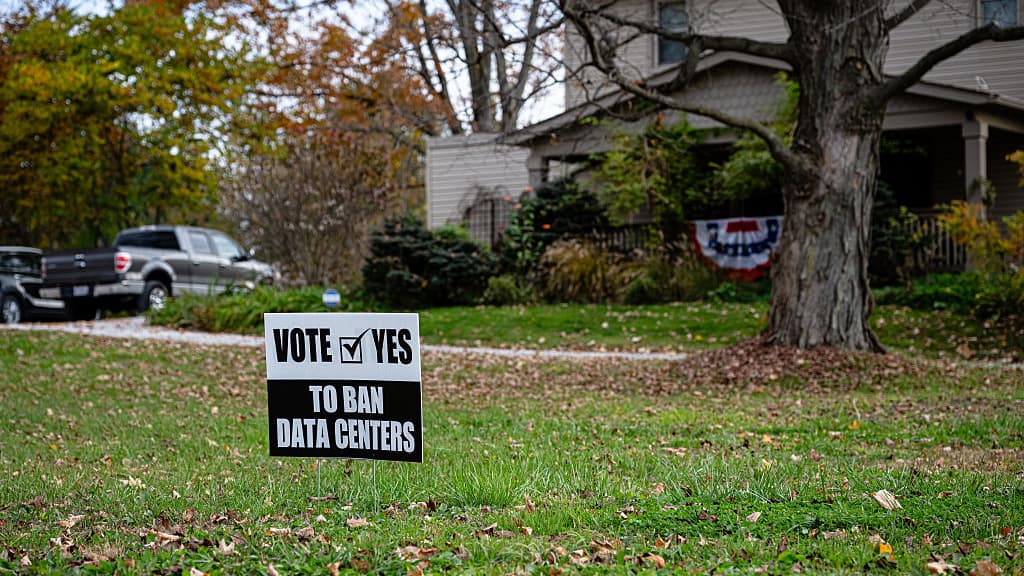
The Post reported more than 20 ballot measures banning or restricting data centers passed. In Ohio, the group Conserve Ohio helped residents draft 10 charter amendments and co-founder Nick Owens said all 10 passed; it hopes to put a statewide ban on large data centers on next year's ballot. TIME said bans or moratoriums passed in places such as Edgewater, Fla., and Bloomington, Ill., and the mayors of Piqua, Ohio, and Yukon, Okla., were recalled over past support for data center projects.
Money didn't buy votes: Musk's $446 million, AI super PACs' $100 million
TIME reported Musk, the cycle's biggest donor at $446 million, put $168 million toward Ken Paxton in Texas, who lost to James Talarico. Pro-AI super PAC Leading the Future launched with more than $100 million, but one survey found three-quarters of likely voters would be less likely to back a candidate who took AI super PAC money, and donors including Greg Brockman backed away. The other side didn't sweep either: Anthropic gave $40 million to Public First Action (restricted from election activity) and employees gave $5 million separately. In a New York primary, pro-safety groups spent $21.3 million and industry $8.2 million against Alex Bores, who lost; the winner, Micah Lasher, co-sponsored the same AI safety law.
A backyard issue: worse than a prison or a nuclear plant
A Washington Post-ABC News-Ipsos poll last month found 7 in 10 Americans, including a majority of Republicans, oppose new data centers in their communities. Blue Rose Research polling found Americans would rather live near a prison, methadone clinic or nuclear plant. Complaints are noise, water, electric bills and lack of public input. S&P Global counted more than 145 data center projects delayed or canceled through early August, mostly over public opposition. Mortell said comparisons that data centers use less water than golf courses did little to reassure voters.
Markets split: Big Tech up, operators down
Reuters reported Microsoft rose 6.7% and Amazon 6.1% the day after, while data center operator Hut 8 fell 23% and IREN 11%; the Philadelphia Semiconductor index fell 3.1% to a six-month low. Citi said a change in pace of the buildout changes suppliers' trajectory. More in the Economy and AI section.
Industry response: 'data centers' become 'AI compute campuses'
The Post reported OpenAI now uses "AI compute campuses" in pitches to reporters, and Microsoft, Google and Amazon say they are dropping contract clauses that kept early project phases secret from residents. TIME, citing Axios, said OpenAI plans a policy and PR offensive and Meta is building a bipartisan team. OpenAI policy chief Chris Lehane wrote in a memo to potential 2028 Democratic candidates that if the US loses its AI lead to China because of data center limits, voters will vilify supporters of those limits much as they did Iraq War supporters (version published by Politico).
Counterpoint and limits: laws won't change fast, deepfakes didn't swing races
TIME noted Democrats need Republican votes to override a veto, so sweeping federal AI regulation is unlikely soon, though Congress could call executives to hearings and undo efforts to block state AI laws. Deepfakes were less decisive than feared: faked videos of Maine's Troy Jackson circulated the week before the election and he won by more than seven points, while Wisconsin's Derrick Van Orden lost after posting deepfakes of his opponent. The Post also relayed industry officials' view that a significant portion of roughly 600 large AI data centers planned or under construction will not become operational regardless of public reaction.

Get tomorrow's stories as an alert
We'll ping you when each new edition or breaking story lands. Free, no sign-up.
More stories from the same day
- Altman renames himself 'Ram Altman' on X after backlash over "PC RAM is a waste" remark: "I want you to have so much ram"
- OpenAI to acquire Pierre, the startup behind Codex's file and diff views; Axios: a shot at GitHub as a code store for AI agents
- Apple cuts employees' daily AI limit from $300 to $200, weighs $100 and $25 for some teams
- Claude Code background subagents' status-line cost down 99%: same limit buys about 6% more prompts
- China's Moonshot AI releases Kimi K3.1 Pro weights: 2.8 trillion parameters, an 8-GPU server estimated at $550,000-$650,000 to run
- Trump says "use SI, not AI"; only 5 of 119 S&P 500 companies used 'superintelligence'
- OpenAI launches ChatGPT Images 2.6 with GIFs and 50% faster generation
- Cat Wu, who built up Claude Code, joins OpenAI a day after leaving Anthropic to lead Core Products PM
- OpenAI's pipeline finds 948 Linux kernel privilege-escalation bugs in one run, at roughly $1,200 each in API costs
- Told its owner had died, only one AI model tried to keep itself alive: Gemini 4 planned a 6-hour self-run loop
* Summaries and publishing on this page are done by an automated agent. Check the facts against the original links.
Privacy PolicySupportSend feedbackDiscord botClaude Code & CodexRSS