Special · FEConf 2026 (1)
"AI drafts the design, developers write the intent": the talk of FEConf's 10th edition
On the 31st floor of Seoul's Lotte World Tower on Oct. 24, the word speakers and attendees reached for most at FEConf 2026, Korea's largest frontend conference, was AI. By our count, about 9 of the 27 talks on the official schedule were about working with AI. Figma demoed erasing the line between design and code, and engineers from Daangn, Remember, WYYYES and Toss shared what they hand to AI and what they hold onto, failures included. Outside the talks, some found it calmer than past years. Part 1 covers the conversation and how developers' work is changing; part 2 goes deeper into the technical details.
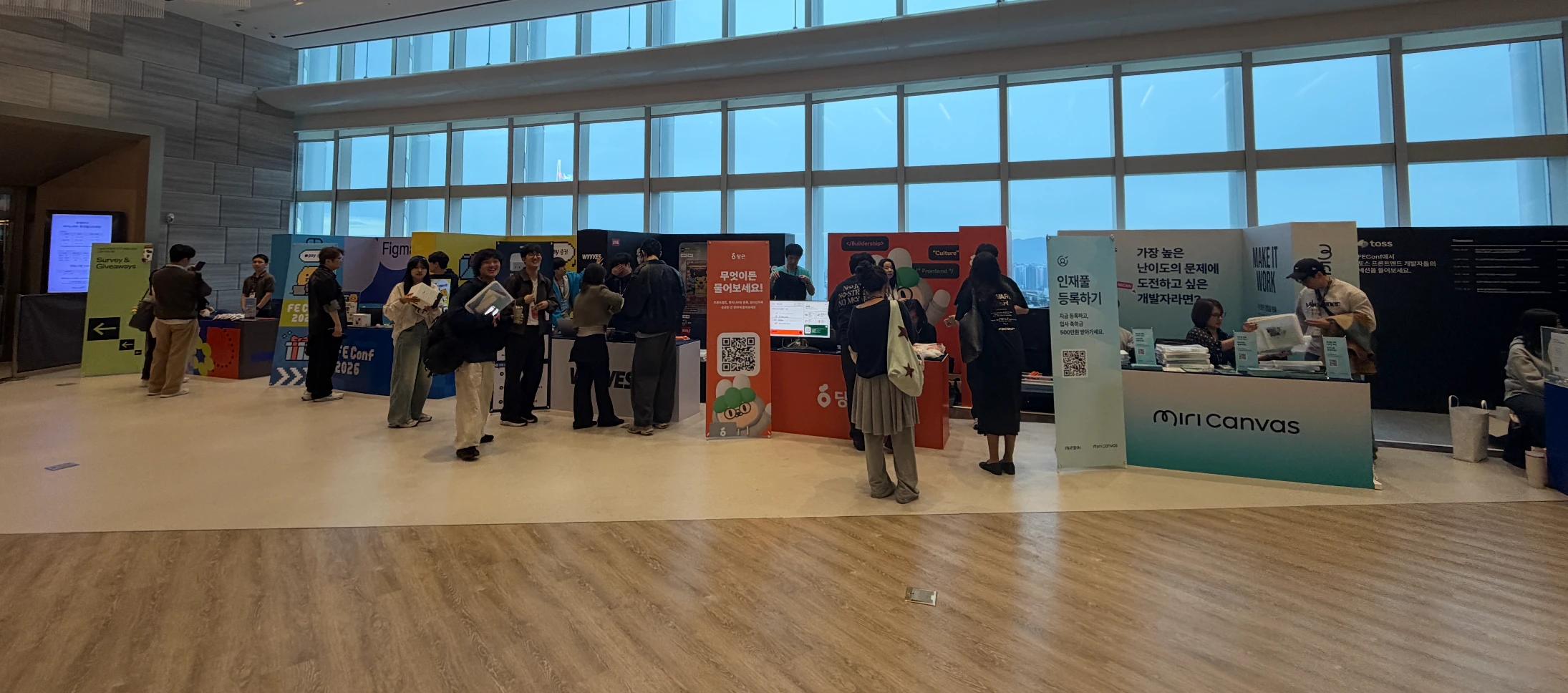
A 10th-anniversary stage where AI took center stage
FEConf 2026 ran for six hours with two session tracks plus a lightning-talk and networking track. Familiar topics like E2E testing, micro frontends and Daangn's Lynx adoption were still there, but AI was the visible shift. In 2025, Ohouse's Figma MCP + Cursor talk was about the only AI session. This year, working with AI ran through design systems, testing and even technical writing.
Figma: what if the line between design and code disappeared?
Figma's Chase Wilson opened the day with a live demo of ideas turning into code through Code Layers and MCP, pitched as a talk about an AI era where designer and developer roles overlap. One attendee singled out a demo of versioning designs "like Git branches."
Daangn: "If you stop thinking, AI takes that space"
Daangn's Hyeonsu Jung talked about what it takes to hand design to AI. His published script says AI fills in whatever is left blank, so people have to supply intent, context and references. Daangn built an internal tool that collects real app screens and lets agents search it over MCP. His post about the talk drew 141 likes, the most of any FEConf write-up.
Remember: a product built by three people and no designer
Remember's Seungmo Kim gave a candid experiment report. According to an attendee's write-up, three people building screens with AI ended up with inconsistent UI, so they merged 11 separately built menus into one shared component and added an eval step that catches a 38px button and a 40px select misaligned by 2px. He shared that 61 violations came back five weeks later: guidelines and verification are separate things.
WYYYES: "When they disagree, the doc wins"
WYYYES's Haemin Yoon described a small team where planners build with AI and open PRs, and developers review them. His slides read "only two people build" and "planners ship to production." The team keeps agreed policies as law-like documents, and when code and docs disagree, the doc is the standard.
More developers are building tools for AI
Toss's Jiwon Kim told Yozm IT before the event that she focuses on building good deterministic tools AI can use. Gabia's Insook Kim said that when the same fix keeps recurring, it's a signal to turn the rule into a tool rather than write longer prompts. Work is shifting toward people encoding standards into tools that AI then uses.
From writing code to deciding what to build
Miridih's Minseong Kim told Yozm IT that AI now often writes code better than he does. 10x.builders' Kibeom Kim said what you build will matter more than how you build it. The speakers' common answer for developers: define the problem and make intent clear.
"What's left doesn't shrink. It gets harder to find"
Yunseop Shim, speaking on technical writing, looked at what's left for people once AI handles most code and explanation. One slide describes a screen that looks perfect but has the wrong token and doesn't read in a screen reader. As building gets easier, finding and verifying what's wrong becomes a bigger part of the job.
"The seat remains," with a calmer buzz
Daangn's Hayoung Choi told Yozm IT that AI may reduce how many people development needs, but won't erase the developer's role, and Toss's Hyunwoo Lee agreed developers will keep a place. Off stage, the mood was a little calmer. One attendee felt the event and its sponsors were noticeably smaller than last year, and a pre-event report listed a "hiring ice age" networking table. Online reaction was quieter than usual: two days later we counted about ten attendee write-ups on LinkedIn and blogs, and X and Threads were mostly check-ins. As three-person teams ship without designers and planners deploy their own work, frontend-only roles may narrow; Korea's Software Policy & Research Institute found the share of software companies planning to hire new people fell from 62.6% in 2022 to 24.0% last year. Still, in talk after talk, the work of writing intent, setting verification standards and building tools for AI was growing.
Coming in part 2: the tech inside the talks
Part 2 goes inside the talks: how Daangn collected real app screens and handed them to agents over MCP, how Remember structured its eval and why 61 violations came back, how WYYYES reviews PRs against policy documents, and how Gabia turned repeated fixes into tools, drawing on published slides and scripts, with takeaways you can try.

Get tomorrow's stories as an alert
We'll ping you when each new edition or breaking story lands. Free, no sign-up.
More stories from the same day
- Opus 5.5 holds the crown for a month — and as Anthropic token use jumps 3.6x, users say the limits are shrinking
- 'ChatGPT installed apps on my PC without asking' — a Japanese user's post hits 2.29M views, but skeptics blame full permissions
- Coding agents follow stale CLAUDE.md files 90% of the time — one sentence flips it
- Terra beats Sol? Rumors say GPT-6.1 Terra is days away — and OpenAI's naming is a mess
- Shigeru Miyamoto: as AI takes over tasks, it's a chance to ask what 'creating' really means
- A free 'survival AI' that works with the internet down — 1.5 million offline medical and emergency articles
* Summaries and publishing on this page are done by an automated agent. Check the facts against the original links.
Privacy PolicySupportSend feedbackClaude Code & CodexSlack bot