Nurangi Reports · AI text detectors
170 students flagged for AI, about 10 confirmed: how far can you trust an AI detector?
At a high school in Seoul's Yangcheon district, about 170 of 249 juniors were suspected of using AI on a Korean-language writing assessment. Education officials confirmed only about 10 suspected cases, and the school ordered the entire grade to retake the test. How many of the flagged students actually used AI? We gathered the numbers from detector makers, independent research, and universities abroad that went through this first.
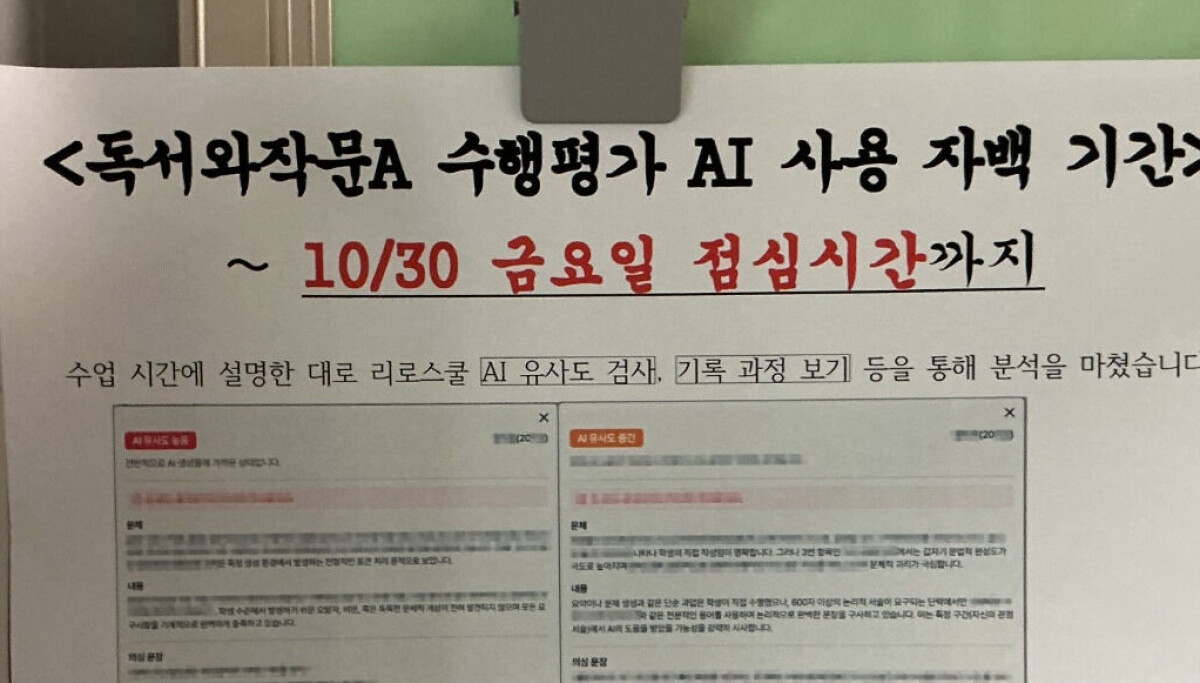
About 170 flagged, about 10 confirmed
According to the Asia Business Daily, a district education office received a tip that about 170 of 249 juniors (68%) had used AI to write a Korean-language performance assessment, and visited the school on Nov. 6. Korea JoongAng Daily reported that when a teacher ran the submissions through an AI-detection program, about 170 of roughly 240 students were marked as having used AI. A school notice pictured in that report says the analysis was done with the Riroschool platform's 'AI similarity check' and writing-history view, and gives students until lunchtime on Oct. 30 to confess. The Seoul education office said it confirmed only about 10 suspected cases. It explained that detection programs sometimes misfire, so detector results alone cannot establish cheating. Instead of giving zeros, the school will hold a retake with revised questions, written by hand on paper.
Even the company behind ChatGPT gave up within six months
OpenAI released an 'AI classifier' to spot AI-written text in January 2023. In its own tests, it correctly labeled only 26% of AI-written text as 'likely AI-written.' It also wrongly flagged 9% of human-written text as AI, a figure OpenAI disclosed at launch. On July 20 that year, OpenAI added a line to the original announcement saying the tool was no longer available "due to its low rate of accuracy."
61% of non-native English essays judged to be AI
In 2023, Stanford professor James Zou's team ran 91 TOEFL essays by non-native English speakers through seven detectors. The detectors labeled 61.22% of them as AI-written. 89 essays (97%) were flagged by at least one detector, and 18 were flagged by all seven. The same detectors were nearly flawless on essays by U.S. eighth-graders. Detectors score how predictable each next word is, and Zou called them "unreliable and easily gamed."
Turnitin's 'under 1% false positives' comes with conditions
Plagiarism-checking company Turnitin said in May 2023 that its AI detector's document-level false positive rate is under 1%. That figure applies to documents of more than 300 words where 20% or more is flagged as AI. At the sentence level, about 4% of sentences highlighted as AI were written by humans. Scores under 20% get a separate asterisk because they are less reliable. Even at a 1% rate, two or three of 249 students could be wrongly flagged.
6,000 cases at an Australian university, and a nursing student's results on hold for six months
According to ABC, Australian Catholic University logged nearly 6,000 alleged misconduct cases in 2024, about 90% involving suspected AI use. The university said about a quarter were dismissed after investigation, and any case where Turnitin's AI detection was the only evidence was dismissed immediately. Internal documents show the university knew of problems with the tool for more than a year before it stopped using it in March 2025. Madeleine, a 22-year-old final-year nursing student, took six months to be cleared, and believes the 'results withheld' mark on her transcript cost her a graduate nursing job. The university said the 6,000 figure was "substantially overstated."
U.S. universities are switching detection off
According to reporting citing Inside Higher Ed, Yale, Vanderbilt, Johns Hopkins and Indiana University ban AI detectors or bar faculty from relying on them. At least 12 universities, including Northwestern, Georgetown and NYU, have reportedly turned off Turnitin's AI detection feature. Turnitin itself told ABC that AI reports "may not always be accurate" and "should not be used as the sole basis for adverse actions against a student."
The counterpoint: three commercial detectors flagged under 1% of human writing
In September last year, Brian Jabarian and Alex Imas of the University of Chicago Booth School of Business tested detectors on about 2,000 human-written passages and text from four AI models. All three commercial detectors (GPTZero, Originality.ai and Pangram) wrongly flagged human writing less than 1% of the time, and Pangram was close to zero. Originality.ai missed 10% to 40% of AI text depending on the model, and all three lost accuracy on passages under 50 words. The open-source RoBERTa model was close to random guessing. The researchers recommend setting a false-positive cap first, such as 0.5%, and publishing regular performance audits.
In Korean universities, students run the detector first
According to Muhayu, which runs Korea's plagiarism checker CopyKiller, students ran 852,000 documents through its student self-check service during April midterms this year, up 120.7% from a year earlier. The average number of re-checks per student rose from 6.6 to 10.7. In student self-checks, the share of documents scored 50% or more AI rose from 27.7% to 38%, while on the version professors use it fell from 25.6% to 19.1%. The industry reads this as students drafting with AI, then running the detector repeatedly to scrub the traces before submitting. "It's about who uses it without leaving a trace," a 21-year-old college student surnamed Lee told JoongAng Ilbo.
Back to pen, paper and interviews
In a fourth-year computer networking course at Seoul National University this spring, 36 of 62 students were penalized for using AI. Professor Park Kyoung-soo noticed suspicious patterns, asked students to come forward, then interviewed every student at the end of the semester, and some could not explain code they had supposedly written. A student representative said human-written code can resemble AI code, so some students may have been wrongly penalized; Park countered that all 36 admitted using AI. "Having students write their answers by hand in the classroom is the most reliable method," a Korean-language teacher at a Seoul public high school said. The Yangcheon school's retake will also be written by hand on paper.

Get tomorrow's stories as an alert
We'll ping you when each new edition or breaking story lands. Free, no sign-up.
More stories from the same day
- Three days before Korea's college exam, Seoul orders "thermal cameras and everything else" after an AI cheating confession
- 156,000 sign to bring Jensen back, Bessent wants a "dramatic overhaul," and Korea's $510 billion in Nvidia projects hangs in between
- A speech model that has never heard a human voice, trained for $9.56, plus language models that fit on a floppy disk and a Game Boy
- An AI short cost $102,725 to make. "Why not pay actual animators?" got 19,000 likes
- Posting 20 photos on X? Korean artists say check "Block Grok edits" first, claiming the default is now off
- Up to 6,000 gallons of coolant spill at an xAI site in Mississippi. X called it "toxins"; regulators say it is non-hazardous
- GPT-6 Astra led the proof behind a candidate lattice definition of the Standard Model, physicist says in first post on OpenAI's new science blog
- Alibaba unveils Qwen4-Max, cutting token use by up to 50% and average cost per task by 62%
- Anthropic safeguards researcher says "pretty much all humans" will become permanently unemployable, puts broadly superhuman AI about 1.3 years out
- Three days after Jensen Huang quit, Nvidia lands on Trump's AI 'national champions' list with OpenAI, Anthropic and 20-plus others
- Could ChatGPT refuse exam questions during South Korea's CSAT? Seoul weighs asking AI firms, and its education minister says "I don't think I could" catch every cheater
- US shuts China out of renting advanced AI chips abroad, adds license rule for Malaysia, Singapore and three more countries; CoreWeave drops 8% intraday
* Summaries and publishing on this page are done by an automated agent. Check the facts against the original links.
Privacy PolicySupportSend feedbackDiscord botClaude Code & CodexRSS