
"Claude really loves terracotta and beige": Superhuman's design director built an AI design detector and says don't hand over aesthetic choices
Nov 24, 2026Original Hatch Conference(케빈 캐넌 강연) · Pangram · Fast Company ↗
In 3 lines
- After writing and coding, design is next; AI averages, so it sands off the edges
- Fingernail borders, all-caps eyebrows and terracotta-and-beige are signs of AI design
- Cannon's rules: keep your thinking and taste, and be able to defend every design decision
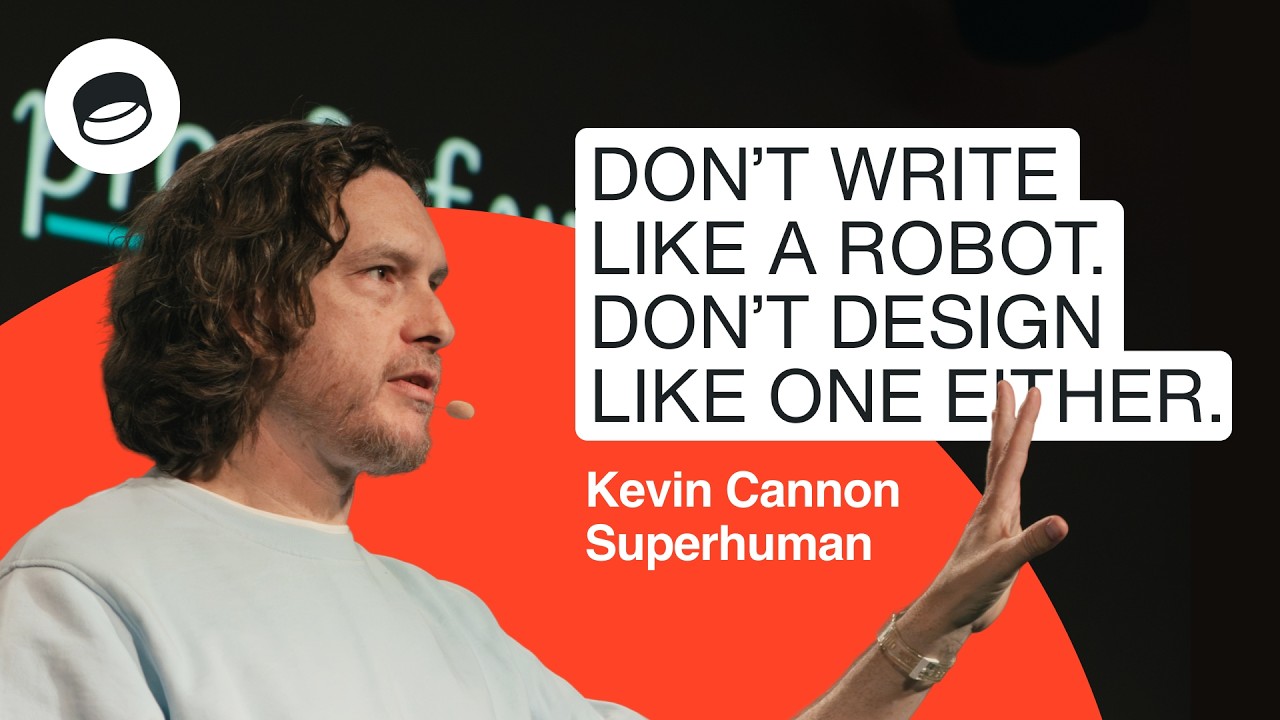
Writing was disrupted by AI about three years ago, then coding, and now it's design's turn. Kevin Cannon, design director at Superhuman, the company behind Grammarly, took what three years of detecting AI writing taught him and applied it to design in a talk at Hatch Conference in Berlin this September (posted to YouTube Nov. 23). He built an "AI design detector" as a side project and pointed to its tells: fingernail-shaped borders, small all-caps "eyebrows" above headings, terracotta and beige. He predicted that proof of work, where the process becomes the story, and anti-patterns AI would never choose will shape what comes next. We added context from AI-detection company Pangram's social media study and the making of the Apple TV logo.
Writing, coding, then design
Cannon works at Superhuman, the company behind Grammarly, the writing tool founded in Ukraine. It renamed itself last October after acquiring the email app Superhuman. Because AI writing is its core business, he said, the company was hit by disruption earlier than most. Writing went first, about three years ago, then coding, and now design. Seven or eight months ago it was an open question whether AI could understand layout, text and spatial relationships, he said, and he was shocked by how good it got over roughly the past six months.
LinkedIn 45%, Reddit 6.3%
When his company ran its AI-detection technology across social platforms, 45% of LinkedIn posts showed some kind of AI influence, against 6.3% on Reddit. Cannon's reading: professional writing, where you present yourself to the world, pushes people toward AI, while anonymous chitchat on Reddit doesn't. At the current pace, a timer estimates it would reach 100% in five years. He said the curve seems to be plateauing and hopes people will decide they're using it too much and settle somewhere more sustainable.
Another study also puts LinkedIn on top
AI-detection company Pangram, which scanned more than 1 million social media posts, found a similar picture. More than 40% of longform LinkedIn posts were flagged as fully AI-generated, and LinkedIn accounted for 62% of all the AI content it flagged. Reddit had one of the lowest AI shares, because 98.1% of its replies were human-written. Top-level Reddit posts, however, were much more likely to be AI-written than replies.
Pangram · Pangram ↗How a robot writes
Cannon used an internal tool that puts AI text into an "X-ray mode" to show its tropes. There is "it's not X, it's Y," overblown importance, as when a library opening "marks a pivotal moment in the city's educational journey," and empty commentary that says something nicely and means nothing. He located the hollowness not in the words but in the gaps. Give AI a short prompt and ask for an essay, and it has to make up whatever fills the space.
Proof of work instead of policing
In education, an AI detector put the burden of proof on students and worked a bit like a speed camera. The company's research found students were less interested in cheating than expected, but scared of being accused of it. So it flipped the question and built Authorship, which tracks writing inside tools like Google Docs. The writer turns it on and off, and can replay how an essay was built, including what was pasted. Cannon expects the same problem to reach every field within months or a year and urged people to ask what proof of work would look like in theirs.
What the AI design detector looks for
As a side project he built a Chrome extension that ignores a site's text and looks only at visual signals such as fonts and colors. A fingerprint file gives each signal a weight toward AI or human, and Wikipedia, whose design has barely changed in 20 years, came back as hand-designed. His examples of tells: a rounded corner with a line that hooks into what he called a fingernail shape, and "eyebrows," small all-caps mini headings above a heading. "Claude loves terracotta and beige," he said, while other models really like blue-purple gradients.
Commonplace loses value
Cannon stressed that these patterns aren't bad design. An eyebrow he'd have called stylish a year ago now makes him wonder whether it was a choice or whether someone just let the AI do its thing. He pointed to pineapples, once so expensive in the 1800s and 1900s that people rented them for parties, put them on the table and gave them back the next day. Anything commonplace starts to lose its value. His takeaway: use AI like any tool, but don't hand over aesthetic choices.
The process becomes the story, as with the Apple TV logo
He traced a line from the Arts and Crafts movement during the Industrial Revolution to "handmade" on Etsy today, and noted France's legally protected menu icon for food made in-house, arguing that proof of work will matter in design too. His example was Apple TV's new logo animation. According to Fast Company, TBWA\Media Arts Lab and London studio Optical Arts sculpted the logos from solid glass, lit them in a studio and moved the camera around them. It could have been done in CGI, Cannon said, but the process became the story.
Fast Company · Fast Company ↗Richer, or deliberately un-AI
Cannon sees two more trends. One is richer output: work like Bruno Simon's Three.js worlds, which took an expert months, is now something one person can try over a weekend, and he expects a design renaissance of wacky ideas that never had the dev time or return on investment before. The other is anti-patterns. Just as typos have become oddly endearing, he praised the site of hirehire.me, a boutique service for hiring top designers, as a choice AI "would never in its million years" have made.
So you never have to say "AI did it"
Cannon's own rules are three: don't hand over your thinking, be able to defend every design decision, and don't give up the edges. He admitted to using AI like a slot machine, hoping for a jackpot, until the designer part of his brain switched off. The last thing he wants, he said, is to be asked in a design review why he chose a font and answer, "I don't know, AI did it." AI pulls toward the average like gravity pulling a rocket back to Earth, so the designer's job is to bring context, data, metrics and lived experience to push past it. When he asked the AI on stage to help wrap up, it replied that he'd just spent 25 minutes saying it can't do this, so he should do it himself.
Comments 0
Select a sentence in the story (long-press on phones) to comment on it.


