Now that anyone can build, are PMs valuable again? Gemini's head of product Tulsee Doshi: "I want PMs who are playing with these models every day"
Nov 16, 2026Original Lenny's Podcast(툴시 도시, 구글 제미나이 제품 총괄) · Lenny's Newsletter · Mind the Product ↗
In 3 lines
- As building got easier, PM openings rose 75% from the March 2023 low, yet PM headcount is still down 28% from 2022
- Doshi says she hires PMs who play with models every day and build their own evals
- PMs move from writing requirements and handing them off to building ahead of the model with a 60/20/20 rule
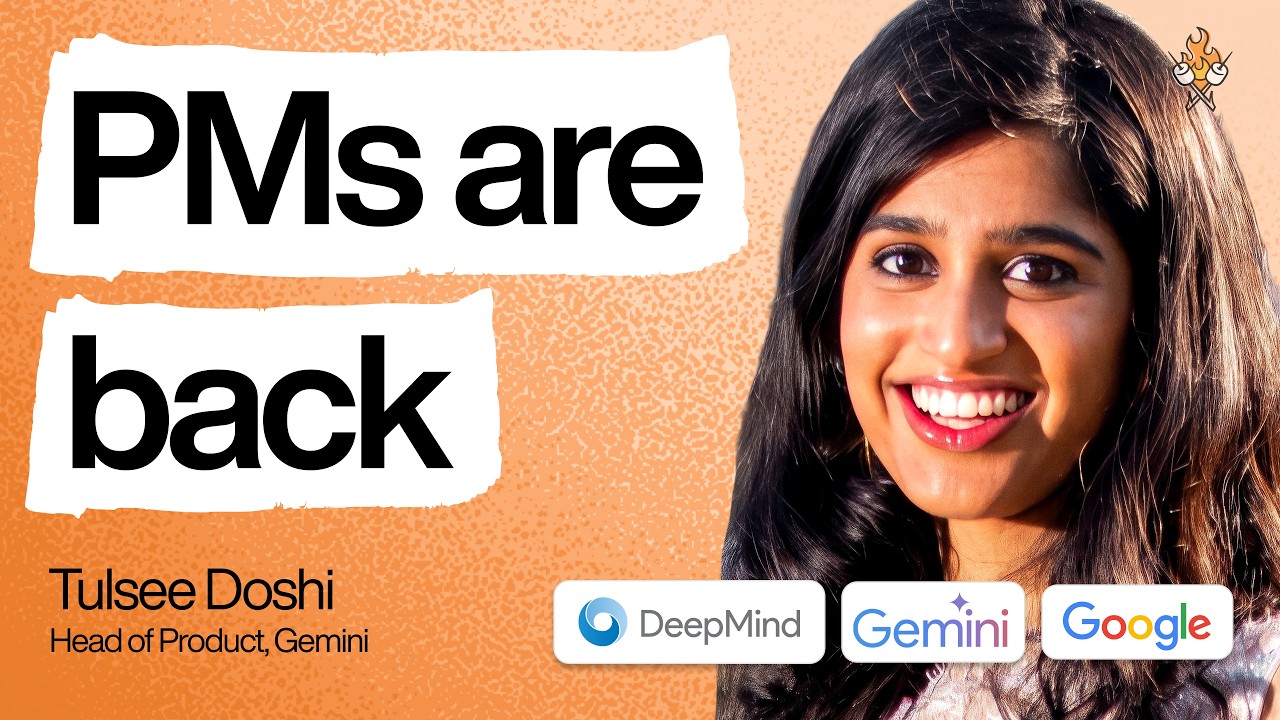
Tulsee Doshi, head of product for Google's frontier models including Gemini, appeared on Lenny's Podcast on November 8. Asked about the chatter on X that PMs are suddenly valuable again after a phase of 'we don't need PMs anymore,' she said that the easier building gets, the more the judgment about what to build is worth. We read the 59-minute conversation, which drew 65,000 views in a week, alongside the job-market report Lenny published two days later and a Mind the Product analysis with numbers pointing the other way.
From 'we don't need PMs' to 'PM ascendance'
Host Lenny Rachitsky noted that X went through a phase of 'we can build anything now, so we don't need PMs,' and that more posts now argue the opposite. With building so easy, people shipped things nobody wanted to use, and realized that picking problems worth solving is a specific skill. Doshi laughed that she is "obviously biased because I am a PM," but said "when you can build anything and you can build anything so easily, building something great actually is now a unique value add." Taste, and the ability to pull the signal from the noise, now matter a lot, she said.
PM openings are up 75% from the 2023 low
Lenny's 'State of the tech job market: late 2026' report, published two days later on November 10, points the same way. Using TrueUp data on job openings at more than 9,000 tech companies, it found "more open PM roles than at any point in nearly four years, up 75% from the March 2023 low." U.S. companies hired about 113,000 software engineers over the past 12 months (May 2025 to April 2026), less than half the 239,000 hired in 2022. PM is the only one of five core roles whose share of hiring grew, from 16% in 2021 to 21%, and 'LLM' is now the most mentioned skill in PM job descriptions, with 'Claude' third.
레니 라치츠키 · Lenny's Newsletter ↗The counterpoint: headcount is down 28% from 2022
Headcount tells a different story. A June analysis by Mind the Product, based on Live Data Technologies data, found that PM headcount at U.S. tech companies is down 28% from its 2022 peak. Management took the biggest cuts, with VPs down 38%, directors 35% and managers 31%, while senior ICs were the most resilient at 21%. The piece also notes that forums are still full of complaints about 'ghost positions' and long job searches.
알렉산드라 치우푸데안 · Mind the Product ↗Someone to turn the chaos of speed into order
The second source of value Doshi named is bringing people together. At a place like Google that builds many products, the ability to build so quickly can itself introduce chaos, she said. That makes someone who can bring people together, drive consensus and "turn chaos into order" really important.
Who she hires: PMs with opinions who use models daily
Asked what she looks for more and more when hiring PMs, Doshi said she wants PMs who "understand the vibes of our models or other models." They have an opinion and play with the models every day, with their own use cases for judging whether a model is good. She also wants PMs technical enough to roll up their sleeves, dig into the data and build an eval. Adaptability rounds out the list: the space changes every two weeks, so a roadmap written two months ago will be rewritten.
Start an eval with five prompts
On how to start writing evals, Doshi said to "start with even just five prompts." Skip the massive benchmark and build a mini evaluation of around 20 prompts that shows signal between model A and model B, with yourself as the rater. In long multi-step, multi-turn trajectories, even defining what good looks like is hard, and collecting good examples alone brings clarity. To sense a new model's vibes, she suggested testing it on tasks you genuinely care about, where models show signs of life but are not yet perfect. She admitted that skill levels still vary a lot among Google's own PMs and the team is working to upskill everyone.
A 60/20/20 rule in place of the MVP
On how far ahead to build, Doshi described a '60/20/20 rule.' About 60% of what you build should work now, 20% should be imperfect but good enough with the model visibly close to getting there, and the last 20% should be where you see only 'glimmers of light' but that would be magical if cracked. Compared with the startup wisdom of building an MVP that works, the idea is a product that grows as the models grow. She has also seen customers build rigid systems around where a model used to be, and advised re-testing consistently whenever a new model arrives.
Models are Snape's potions class, and model personality is UX
Doshi compared model development to Snape's potions class in Harry Potter. You put in all the ingredients and set expectations, but "there will be a little bit of magic," and that magic is always surprising. So a model PM's job continues after the ingredients are chosen: find where the model shines and shape that into something amazing for users. How transparent the model is, how it communicates and what questions it asks back are all UX, she said. Google's PMs work with a model behavior team to write a spec for what good looks like for Gemini, then translate it into rubrics, data and reward modeling.
What 'X is the new PRD' really means
Posts saying 'a prototype is the new PRD' or 'evals are the new PRD' are popular. Doshi read them as a shift in the PM's position. PMs used to write down requirements and assume a data scientist, engineer, researcher or designer would figure out the rest; now they have to go one step further and bring some heft, in whatever format. On AI-written docs, her rule is that the insight should come from you and the data from the model. A report two weeks after launch on who is using a feature, pulled from dashboards and social reactions, is something AI does far faster, but the judgment on top belongs to people.
Burnout comes from chaos and grunt work
Doshi was candid that everyone on her team is putting in all of the hours and that she is still thinking about how to create a sustainable work environment. She traced burnout to churn and chaos, and to work people don't enjoy. In November she planned a two-day workshop that pulls every PM out of their day job just to build and play with the tools, and she described asking 'if you have to do something twice, do you need to do it yourself?' and a shared repository of AI skills the team builds for each other. Lenny added that in his survey of tech workers, more hours did not equal burnout, and many said they were working the hardest and having the best time of their careers.